
Africa’s economic transformation will not be achieved simply by exporting raw minerals.
It will be built through infrastructure, logistics, energy systems, and industrial capacity.
That is the vision driving IBS Group, a Guinean company that has quietly become one of the strategic pillars behind mining and infrastructure operations in West Africa.
Founded in Conakry 15 years ago, IBS Group positioned itself where one of the continent’s biggest industrial gaps existed:
bridging world-class industrial technologies with the operational realities of African mining projects.
Because building and operating large industrial sites in Guinea remains a massive logistical challenge.
Remote mining zones require:
- Continuous power supply
- Secure telecommunications
- Industrial automation systems
- Equipment maintenance
- Camp management for thousands of workers
- Reliable logistics chains
For years, multinational companies relied almost exclusively on foreign service providers to solve these problems.
Today, IBS Group is proving that a local African company can compete at international standards.
A Local Company Connected to Global Industrial Giants
Under the leadership of Aguibou Ly, IBS Group understood early that competitiveness in modern industry requires more than local presence.
It requires strategic alliances.
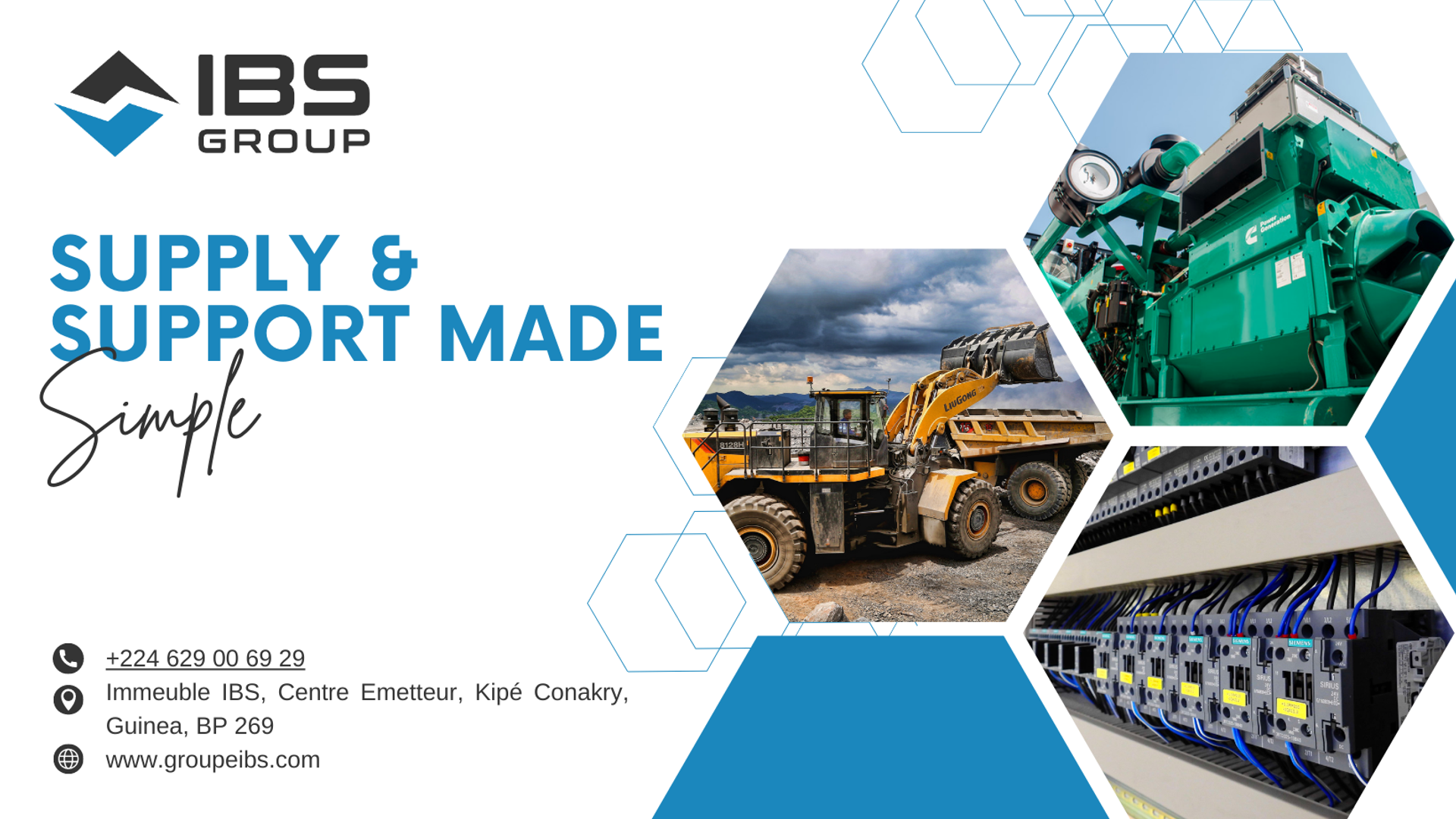
Through its subsidiary IBS Technologies, the company became an official distributor and systems integrator for some of the world’s most respected industrial brands:
- Siemens for electrification, automation, and microgrid solutions
- Cummins for industrial diesel generators and energy systems
- Motorola Solutions for communications and secure radio networks
- Timken for mechanical transmission systems and industrial bearings
But IBS does not simply import equipment.
The company positions itself as a full-service industrial partner, covering:
- Feasibility studies
- Engineering support
- Infrastructure integration
- Camp construction
- Maintenance operations
- Technical support
This “360-degree” approach is precisely what large mining operators increasingly demand in Africa.
The Power of Joint Ventures and Human Capital
What truly differentiates IBS Group is not only technology.
It is strategy.
Instead of remaining a traditional local supplier, the company built specialized joint ventures designed to scale industrial expertise inside Guinea.
IBS partnered with international construction group Copisa to launch SIMI, focused on engineering and industrial construction.
It also joined forces with the Aden Group to create KRSS, a company specializing in integrated camp management services for mining operations.
Today, KRSS manages catering, accommodation, and operational support for more than 1,500 workers across four major mining sites.
Behind this industrial ecosystem stands a growing generation of Guinean professionals.
Employees like Ismaila Syli Sow, a stock manager within the group, represent the invisible backbone of industrial performance. In large-scale operations, a single supply chain disruption can stop entire production systems.
That is why logistics expertise is becoming one of Africa’s most strategic skills.
Simandou 2040 and the Rise of Local Industrial Champions
As Guinea prepares for the massive Simandou 2040 transformation, IBS Group’s trajectory offers a glimpse into the future of African industrialization.
The company has already positioned itself at major international business platforms including the Guinea–France Business Forum and the Africa CEO Forum, where discussions increasingly focus on one central issue:
How can African economies capture more local value from industrial megaprojects?
IBS Group’s answer is clear:
through local capacity building, technology transfer, and strategic partnerships.
Rather than remaining dependent on foreign execution, Guinea is beginning to develop companies capable of operating at international standards while understanding local realities better than any external contractor ever could.
That shift matters far beyond Guinea.
Because Africa’s industrial future will not only depend on foreign investment.
It will depend on the rise of local companies capable of building, powering, and sustaining the continent’s next generation of infrastructure.