
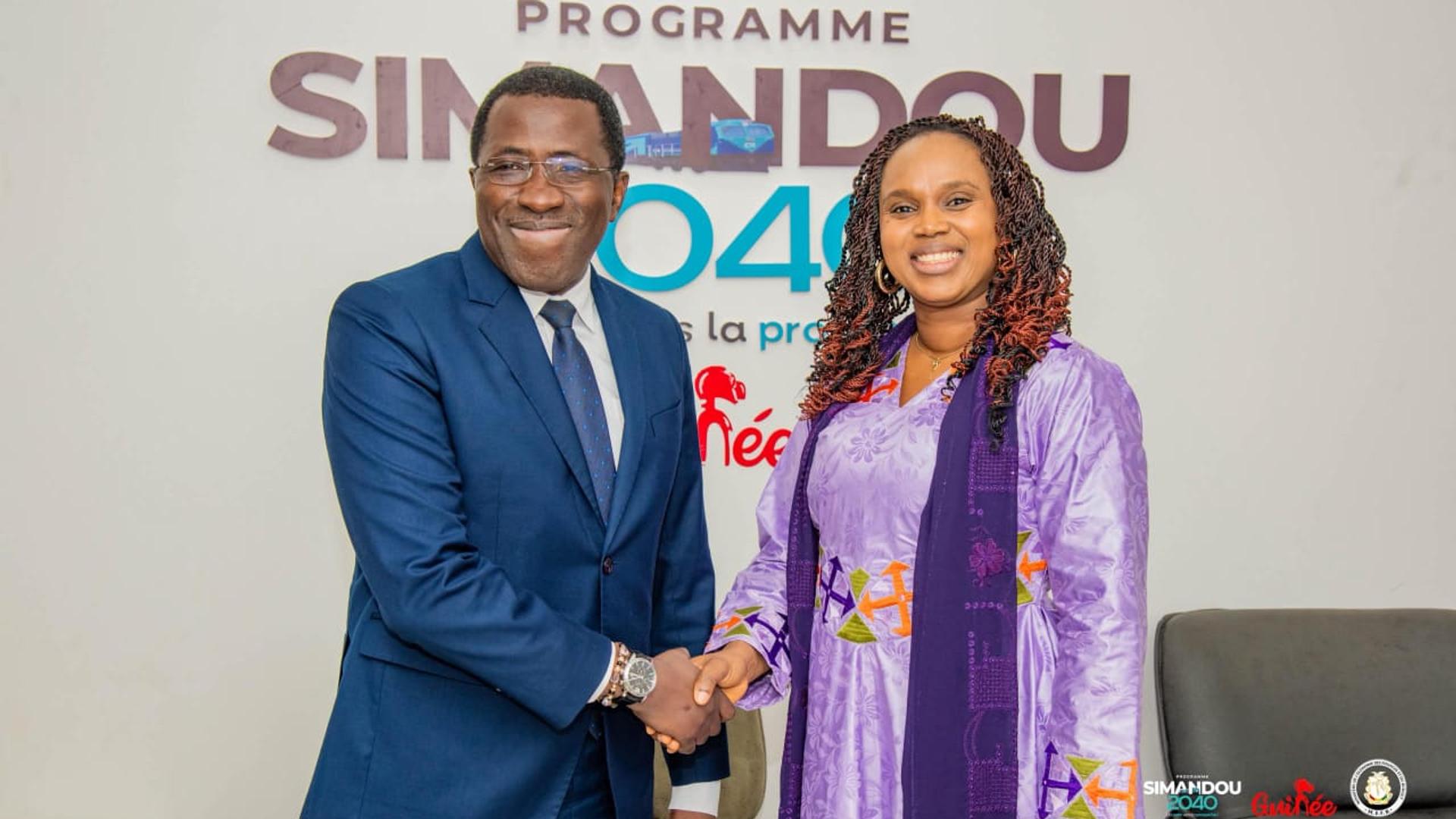
The economic leadership of the Republic of Guinea is presenting a unified front, and this absolute consistency in baseline data stands as a critical asset before the Bretton Woods institutions. On Monday, June 15, 2026, in Conakry, the Minister of Economy, Finance, and Budget, Mariama Ciré Sylla, officially initiated technical working sessions with a high-level mission of experts from the International Monetary Fund (IMF).
Introduced by Mr. Wautabouna Ouattara, Guinea’s Executive Director at the IMF, this delegation has entered a two-week negotiating window. The core corporate target is to co-construct an ambitious, formal economic and financial program that directly aligns with the executive vision of the Simandou 2040 socioeconomic development program.
The Unified Doctrine of Guinea’s Economic Framework
To approach this international auditing process, the government strategically structured its position beforehand. On June 12, under the joint coordination of the Minister of Planning, Ismaël Nabé, Minister Mariama Ciré Sylla, and the Governor of the Central Bank (BCRG), Dr. Karamo Kaba, the Macroeconomic Budgetary Framework Committee formally validated the provisional economic data covering the 2025–2027 period.
This internal data reconciliation eliminates traditional statistical gaps between separate ministries, which historically weakened the state’s position during international audits. Moving forward, the national trajectory is strictly mapped onto the 2026–2030 Programming Law recently ratified by the National Transition Council (CNT).
From the opening sessions, the Governor of the BCRG put forward concrete, tier-1 macroeconomic indicators:
- Economic Growth Exceeding 8%: A high-velocity performance positioning Guinea among the fastest-growing economies on the continent, neutralizing global logistical cost increases and geopolitical friction.
- Controlled Inflation Targets: Projected consumer index inflation rates remain perfectly aligned with the strict regional community convergence criteria.
- Consolidated Foreign Reserves: A robust cash reserve cushion ensuring that the national public debt distress risk rating is maintained at a sustainable "moderate" level.
Retrospective 2021–2026: Moving from Emergency Response to Structural Scaling
The program currently being negotiated marks a structural departure from the restrictive Structural Adjustment Programs (SAP) of previous decades. The contemporary partnership between Conakry and the IMF relies on shared risk management and co-constructed policy design.
The IMF demonstrated this agile cooperation following the domestic infrastructure crisis of December 2023 (the Kaloum fuel depot explosion) by approving a $71 million Rapid Credit Facility (RCF) disbursement in May 2024 to protect the country's balance of payments. This immediate injection was supported in late 2025 by the Local Economic Resilience Fund, directly financing micro-projects for women and vulnerable households impacted by the Kaloum incident.
For the 2026–2030 strategic cycle, active technical assistance is shifting completely toward maximizing domestic resource mobilization. Experts from the Public Finance Reform Technical Unit (CTSP) and the IMF are collaborating on the digital transformation of tax filing and payment platforms, alongside optimizing the mining fiscal regime for Simandou. This structure guarantees that raw extractive revenues are seamlessly converted into permanent transport infrastructure, advanced healthcare setups, and national educational systems.